


Monochrome Monday
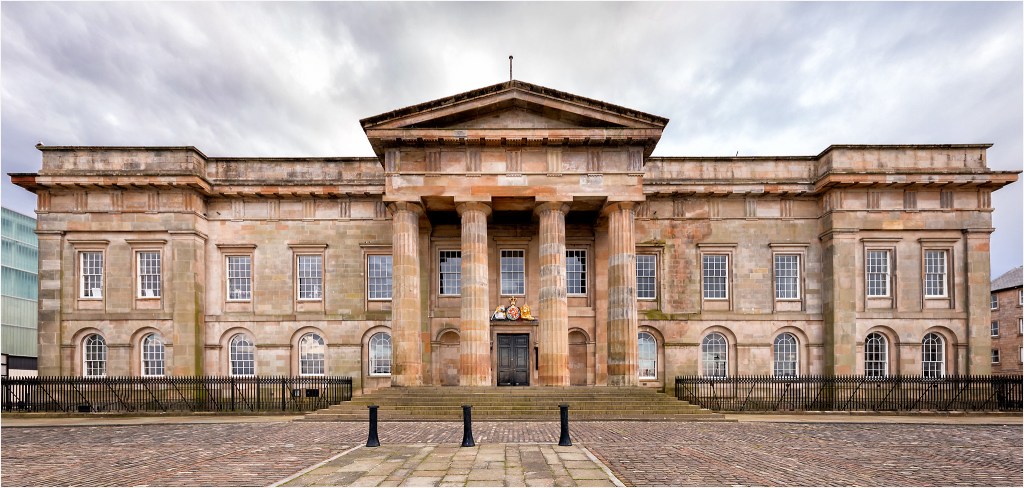
Wouldn’t you like to work in such an impressive, stately building?
I created this image about a year ago. It is really three photographs merged together as a panorama wrapped round a cylinder. A version taking away any perspective is shown later.
When Black Lives Matter hit the headlines again last month, I looked back on this image in a different light.
The building was renovated around ten years ago and is now an exclusive office complex situated on the sea front with views across the Firth of Clyde. But it was originally built in 1818 as the Customs House for the port of Greenock, near Glasgow.
Greenock had for some time been a centre for sugar refining in Scotland, and in the early 1800s, masses of raw sugar were being imported here from plantations in the West Indies. The building was built to replace its smaller predecessor so that the many importers of sugar (and other goods) could pay their import duties and taxes to the UK government. It was built with some style … a bit of grandeur…the face of Empire.
There were so many rich magnates operating in Scotland, who imported sugar, tobacco and cotton, and whose profits came out of the labours of Black African slaves, and the whole of the Scotland’s economy was boosted by the trade. I understand the traders felt hard done by having to pay tax at all and, such was the strength of the sugar lobby, that the UK Government held Sugar Tax on imports from the West Indies below the level of tax on sugar imported from other parts of the world. The association between this grand building and slavery makes me feel somewhat uneasy. It was a different world then indeed.
Looking back in my family tree, I’m pretty certain that there are no slave owners or sugar importers among my ancestors but there are tradesmen and business men whose turnover would have been increased by the ‘trickle down effect’ from all this wealth. In fact, all parts of the Scottish and UK (and many other) economies benefited, and vast amounts of revenue and capital came to us all this way.
There will not be a town in Scotland which does not have old buildings that were in some way linked to the trade of sugar, cotton or tobacco.
Over the last month, a debate has resurfaced round the history that is taught in schools. I remember we were taught all about the Scottish Wars of Independance in primary school but we never learned anything about the profits of Empire – only about some of the battles won. We all need more understanding of this history.
Certainly makes you think!
 jazziBeeblog